OUTLOOK REPORT
Shaping the Future of Food
Photo courtesy of MF3d / iStock / Getty Images Plus
As 2025 draws to a close, advancements in artificial intelligence (AI) are reshaping the future of food. From boosting yield and powering innovation through scaled solutions, to reducing downtime and optimizing brand strategy, recipe development and engagement, AI is well past the “tech hype” in dairy plants and ingredient companies.
Saar Yoskovitz, who co-founded his predictive and prescriptive machine health company, Augury, in 2011, notes that AI is well past the hype cycle on plant floors.
“We see reliable AI used every day by dairy processors to keep assets healthy, reduce unplanned downtime, improve yield, and cut waste,” he explains. “Machine Health, for example, uses sensors and AI to predict failures before they happen, saving thousands of dollars in unplanned downtime and preventing product loss. Those are tangible metrics dairy processors are able to track and see the ROI [return on investment] of their AI investments.”
By Barbara Harfmann, Senior Editor
The transformative technology of AI improves yield, cuts waste and solves operational challenges.
Shaping the Future of Food

New York City-based Augury’s third-annual State of Production Health report, which surveyed more than 150 food and beverage (F&B) manufacturers, found that machine health, prescriptive analytics and process health are the top AI use cases.
Yet, what do dairy manufacturers want AI to do?
“They most want AI to help with quality, yield and throughput,” Yoskovitz tells Dairy Foods. “Many teams feel confident, yet some still struggle to prove the impact of their AI pilots because they’re not tied to business goals or developed to scale. That is where ‘pilot fatigue’ sets in. Teams lose interest, value isn’t proven, and momentum stalls. When you focus instead on solving specific operational problems, the results then speak for themselves.”
Abhishek Roy, senior director for global digital and AI at Cargill, concurs AI is “transformative technology” used in everyday workflows at the Wayzata, Minn.-based headquarters and more than 70 countries worldwide.
“As we work to shape the future of food, AI is enhancing our ability to innovate and scale solutions that can transform how the world grows, makes and moves the products our customers and consumers depend on,” he says. “AI is already accelerating our food formulation work — enhancing processes, increasing speed to market and improving accuracy.”
“The good news is that companies don’t need to build AI from scratch. FoodChain ID is investing heavily in R&D capabilities to apply artificial intelligence directly into food and beverage use cases. Our primary goal is to allow customers to enjoy the benefits of AI without having to ‘re-invent the wheel.’”
— Wes Frierson, vice president of enterprise solutions at FoodChain ID

As an example of how AI is being used to “nourish the world in a safe, responsible and sustainable way,” Roy notes that its food scientists are using AI in recipe discovery by analyzing ingredient interactions, optimizing formulations and generating recommendations of novel recipes based on target parameters and consumer preferences.
AI-driven research tools also are being used by the agribusiness company to speed knowledge sharing and product development. “Our teams use AI to support everything from optimizing fermentation processes to microbiome assessments and ingredient reformulations, helping bring new solutions to market more quickly, using ingredients that meet fast-changing consumer preferences,” he explains.
The engine of innovation
Wes Frierson, vice president of enterprise solutions at Fairfield, Iowa-based FoodChain ID, knows it’s easy to discount “tech hype” since many technology trends during the last 20 years have not been “game changers.” However, the opposite is true of AI.
“AI will be the most transformative technological innovation in our lifetime. As a technology leader in the agrifood industry, FoodChain ID advises our clients to act now for the competitive advantage,” Frierson says. “…We see adoption across a continuum. Many companies have jumped into the potential and invested heavily, while others are still trying to figure out where to start.
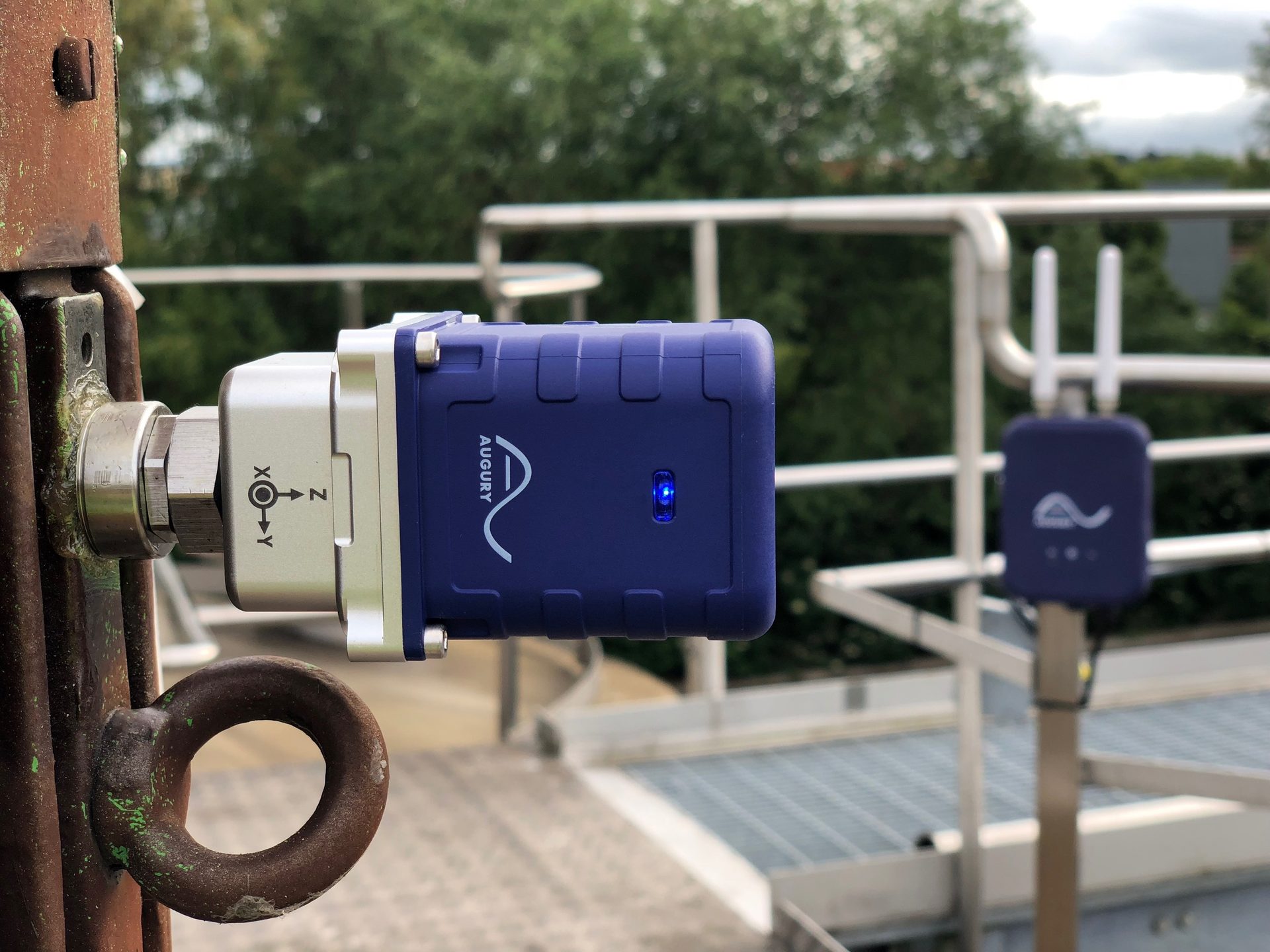
Augury's sensors and node at work in an outdoor industrial environment. Photo courtesy of Augury.
“Our client-facing teams report about 80% of our conversations this year include customers asking us how to get started to see the benefits of AI,” he adds. “If a company does not set measures of success from the start, AI can be very expensive.”
Automation and AI are vital innovation tools that are reaping big benefits as they scale up. The warehouse automation market is expected to reach $90.7 million by 2034, growing at a compound annual growth rate (CAGR) of 15.1%, according to Allied Market Research.
AI implementation is skyrocketing. New York City-based McKinsey estimates AI could add $2.6 to $4.4 trillion of global productivity annually, with $40 to $70 billion to come from agriculture.
Augury’s Yoskovitz highlights that AI adoption has more than tripled in just one year — from 4% of companies scaling AI across sites to 14% — according to its aforementioned report.
“In food and beverage, 16% say they’ve rolled out more than half of their AI pilots across plants, making this one of the most advanced sectors for scaling digital tools,” Yoskovitz says.
AI and dairy companies
Yoskovitz highlights a dairy company making cheese, whey and liquid milk products who wanted to improve production output, reduce costly product waste, and improve safety. Unfortunately, its 24/7 operation was being hampered by unexpected machine failures, which greatly impacted their facility, their network of sites, and their farmers.
“When their network was full, extended downtime events forced them to dump milk and emergency fixes meant firefighting for their teams and long lead times for parts or replacements,” Yoskovitz explains. “Their existing vibration analysis solution was not continuous and didn’t catch machine issues in advance. They wanted a new solution to provide accurate, early insights into machine failures and clearly communicate prescriptive actions."
Prior to investing in AI, FoodChain ID’s Frierson recommends the following:
- Partner with a company with the technological prowess to build AI in the food and agriculture industry.
- Set up a specific plan for AI that covers problems to solve or efficiencies to advance.
- Look for proven tools designed for the agrifood industry, such as advanced AI agents inside software that can simulate advice and reviews one would get from senior product developers and compliance experts.
“The good news is that companies don’t need to build AI from scratch,” Frierson notes. “FoodChain ID is investing heavily in R&D capabilities to apply artificial intelligence directly into food and beverage use cases. Our primary goal is to allow customers to enjoy the benefits of AI without having to ‘reinvent the wheel.’ …Our AI tools can evaluate product formulation, deep underlying data, simulated outcomes, and product objectives and provide very specific advice and warnings.”
The company recently introduced AI capabilities in its software: FoodChain ID Mentor. This AI solution helps streamline formulation and product innovation and reviews, enforce brand and customer standards, and scale internal expertise.
“Since our announcement earlier this year, the response to this capability has been extraordinary,” Frierson attests. “Customers understand the benefit right away. Mentor turns their scattered internal knowledge into live, expert guidance. They are even more excited by the Mentor roadmap, which will allow our clients to evaluate and activate changes across the entire portfolio, enabling opportunities that would have been seen as impossible just a few years ago.”
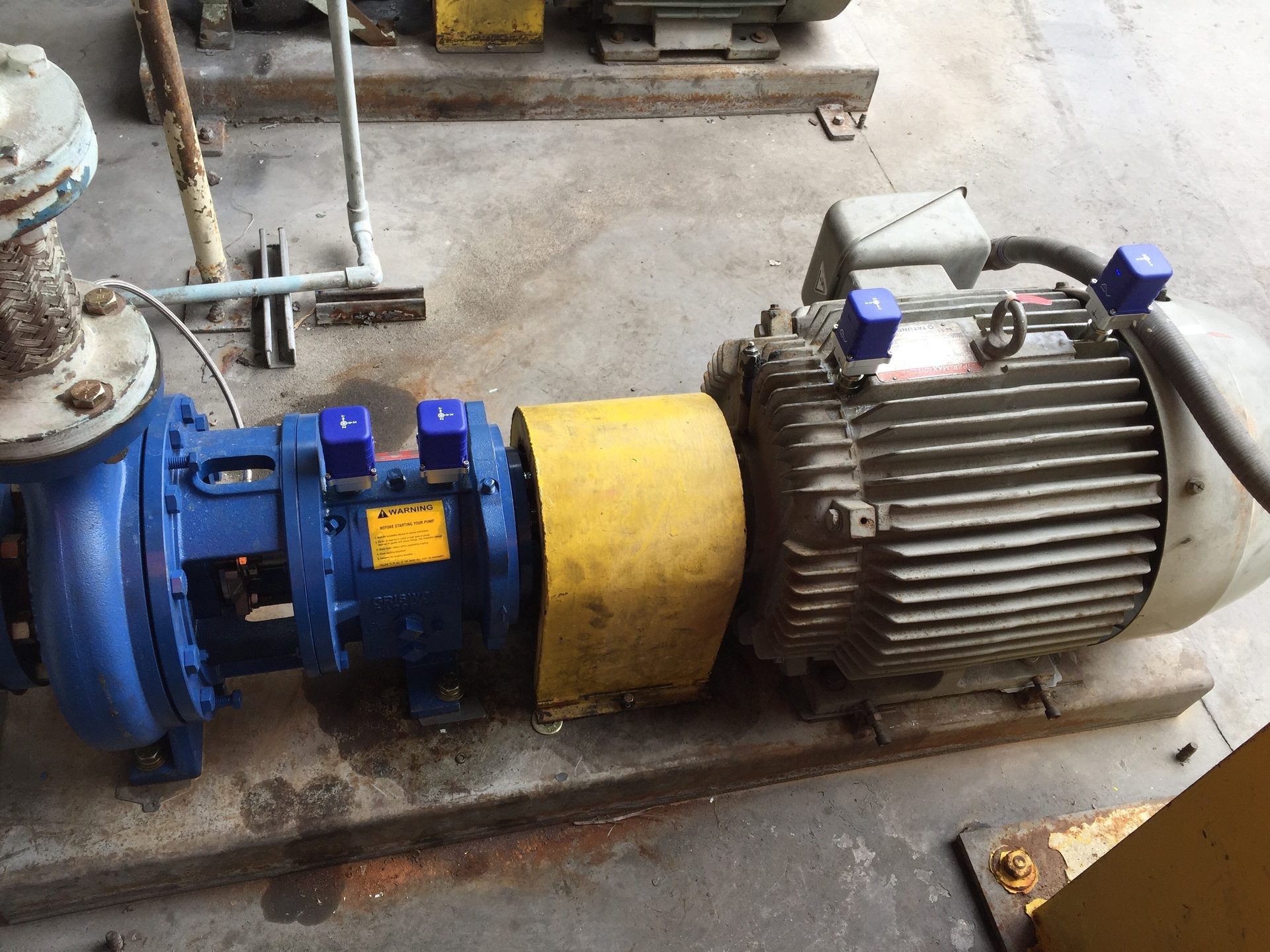
Machine Health sensors monitor an overhung centrifugal pump.
Photo courtesy of Augury.
Experts note that AI capability is exciting because it helps both senior and junior team members work more effectively while providing idea starters for customer collaborations.
“The AI agent supports the team and ensures that the organization’s standards, best practices and learnings are incorporated and creates a continuous improvement loop,” according to Frierson.
Cargill’s Roy concurs the AI engine not only expands the speed and scope of what’s possible but consistently relies on company experts for final analysis and application.
“For example, Cargill developed an AI-enhanced ideation tool called ‘Ask Emma,’ which draws on a large internal repository of concepts, ideas and industry trends. It helps teams develop personas, jobs to be done, themes and idea starters for customer collaborations,” Roy states.
Another benefit: AI also is getting easier to integrate. “Modern Machine Health systems combine IoT sensors with AI and human expertise. They continuously monitor assets and flag problems early with over 99% accuracy, verified by trained vibration analysts,” Yoskovitz explains.
Transforming how the world grows
Augury’s Production Health Report suggests that food and beverage manufacturers face more supply chain pressures than any other section with 15.7% who flagged it as their top barrier to meeting production targets.
“Food and beverage leaders are under constant pressure to maintain production despite labor shortages and volatile supply chains,” Yoskovitz explains. “AI helps keep operations stable by improving reliability, optimizing energy and water use, and reducing waste. When a line fails, a dairy producer can lose $5,000 to $20,000 per hour, and that doesn’t count the wasted milk or cleanup cost. AI-driven predictive maintenance insights prevent these losses by detecting issues early and guiding maintenance teams before failure occurs.”
Beyond stabilizing production, AI also is easing the strain of ongoing labor shortages. Predictable, planned downtime means technicians can schedule maintenance in advance instead of working reactively and taking unplanned overnight shifts.
“This predictability creates better work-life balance and safer conditions for employees,” Yoskovitz suggests. “The technology also helps capture institutional knowledge as experienced workers retire. AI systems record patterns, insights and maintenance steps that used to live in someone’s head, allowing newer employees to learn faster and make confident decisions.”
Cargill’s Roy notes that AI will give dairy producers more control and substantially enhance its ability to innovate and scale solutions in R&D, marketing, software engineering and more.
“AI can accelerate our innovation efforts, enhancing our teams’ brainstorming, ideation, discovery and creativity efforts,” he concludes. “It can also improve existing AI applications by generating synthetic data, code and content. AI will transform how the world grows, makes and moves the products our customers and consumers depend on … today and for generations to come.” DF