OUTLOOK REPORT
Flavor and Taste Dominate
Photo courtesy of Sofiia Tiuleneva / iStock / Getty Images Plus..
On a cold winter’s night, most of us love the aroma, taste and warmth that a steaming hot mug of tea or coffee provides, not to mention the top-boosting antioxidants (polyphenols) that fight cell damage, reduce inflammation, and protect against chronic diseases. And when we’re fighting a cold or the flu, we inevitably turn to the immune-boosting properties and vitamin C contained in orange juice.
Ready-to-drink (RTD) beverages like coffee, tea and juice benefit from diverse flavors, textures and aromas such as fruity, nutty, creamy and robust. There’s also a plethora of options for every style and taste, including bottled, canned, refrigerated, shelf-stable, loose-leaf, hot, iced and cold brew.
As for which categories are doing well and which are slumping, Dairy Foods turned to Sally Lyons Wyatt, global executive vice president and chief advisor of consumer goods and foodservice insights at Chicago-based market research firm, Circana.
“RFG Tea and Coffee (+1%), Aseptic Juices (+2.9%) and Canned Juices (+3.1%) have performed better in unit sales (52 weeks ending 11/2/25) vs. a year ago,” Lyons Wyatt says. “Within RFG Tea and Coffee, we find RFG RTD Coffee driving unit growth at +4%. Conversely, RTD Tea and Coffee has declined (-4%), RFG Juices and Drinks (-3.5%), and Shelf Stable Bottled Juices performed negatively (-4.2%).”
By Barbara Harfmann, Senior Editor
Refrigerated tea/coffee and aseptic juices capitalize on growth, while RTD tea/coffee slump 2.2%.
Flavor and Taste Dominate
Loom’s signature juice-meets-water blends offer bold flavor with low sugar, low calories, and real ingredients. The 30-calorie, RTD juice is available in six flavors: Moon Punch, Dark Cherry, Aurora Orange, Midnight Mango, Beyond Apple and Cosmic Candy Grape. Photo courtesy of Loom.
Outlook wise, the Circana expert notes that Cold Brew continues to grow and outpace the segments above but refrigerated RTD Coffee is also generating growth.
Albeit from a small base, the cold brew segment grew its dollar sales 14.3% year-over-year (YoY) to nearly $246 million, while refrigerated RTD coffee “froze out” the competition with a 5% YoY climb and dollar sales of $1.3 billion for the 52 weeks ending Nov. 2, 2025, Circana data reports.
Citing data from New York-based Nielsen, Karyn Cook, senior marketing manager at Balchem Corp., notes that RTD Coffee (-8%) and Juice (-7.1%) are both down in retail volume year over year for the 52 weeks ending Nov. 1, 2025.
“Coffee appears to be suffering from a sustained and long-term shift to energy beverages that show no signs of slowing consumption,” Cook notes. “Juice is negatively affected by sugar content. Tea is managing to grow in both dollar (+1%) and volume (+0.2%) with growth brands implementing natural and simple ingredients or lower sugar.”
Odwalla introduced several new juice beverages and smoothies in fruit-forward flavors like Strawberry Banana and Green Juice. Photo courtesy of Odwalla.
The Montvale, N.J.-based specialty ingredient's company suggests that refrigerated beverages are performing better than shelf-stable products.
“Rising packaging and ingredient costs have driven up overall product prices, limiting the ability of shelf-stable options to adjust pricing without compromising perceived value,” Cook explains. “In contrast, refrigerated products benefit from a stronger quality perception, giving them more flexibility for price adjustments and maintaining consumer appeal.”
Across RTD coffee, tea and juice, Emily Berg, marketing manager at Wayzata, Minn.-based Cargill, is seeing overall declines as the broader beverage landscape becomes more crowded.
“Consumers have an abundance of choices today, and competition for each drinking occasion is intensifying,” Berg explains. “As new beverage spaces and subcategories emerge — from hydration boosters to functional energy formats — traditional RTD categories are fighting harder to maintain share. That said, there are pockets of growth.
“We’re seeing momentum in segments that tap into long-running marketplace trends like less sugar, cleaner labels and functional benefits,” she continues. “Products that meaningfully deliver on those expectations continue to outperform category averages.”
With 100mg of naturally derived caffeine per serving, the 45-calorie Uncle Matt’s Organic Yerba Mate Energy Tea is brewed with organic yerba mate leaves, organic lemon juice and organic green tea caffeine. Photo courtesy of Uncle Matt’s.
Most popular segments and packaging
Looking at dollars YTD 2025 and compound annual growth rate (CAGR) between 2022-24, Circana’s Lyons Wyatt suggest that consumers are most likely to purchase aseptic, canned and refrigerated segments.
“Overall buyers are making less trips and spending more per trip,” she says. “Bottled Juices and RTD Tea and Coffee subcategories which have the most penetration saw the most decline in product trips per buyer.
“Purchase frequency (trips/buyer) increased for Aseptic Juices and Drinks, Canned Juices and Drinks, RFG Coffee, Aseptic Juices, and Canned Juices,” she adds.
Despite a 0.4% decrease, the No. 1 top-selling category was the $9.3 billion shelf-stable bottled juice category that boasts 22 flavors, per Circana data. Bottled fruit drinks and bottled cranberry cocktail/juice drink were shining bright with $2.6 billion (-5.3%) and $1.4 billion (-0.6%), respectively, in basket rings. Bottled apple juice, with 1.1% growth, saw sales of $1.3 billion.
At 27% growth and No. 13 on the list, shelf stable bottled other generated $154 million in sales, while bottled pineapple juice and bottled fruit nectar grew 15.1% and 15.8%, respectively, while generating $106 million and $81 million in sales for the 52 weeks ending Nov. 2, 2025, according to Circana data.
Albeit from a smaller base, shelf-stable bottled juice and drink smoothies rose 46.2% to the tune of $68 million.
Balchem’s Cook, however, notes that refrigerated beverages are performing better than shelf-stable products.
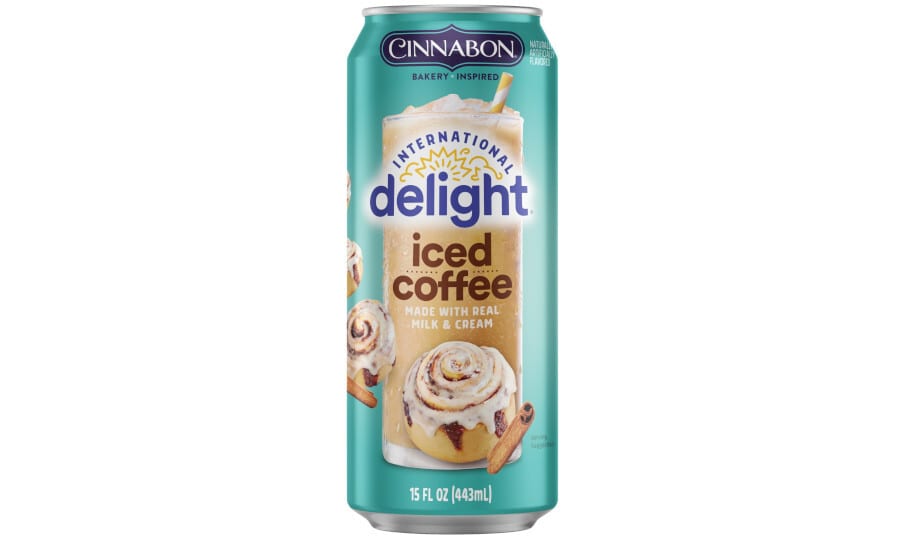
International Delight debuted Cinnabon Iced Coffee cans. Photo courtesy of International Delight.
She comments: “Rising packaging and ingredient costs have driven up overall product prices, limiting the ability of shelf-stable options to adjust pricing without compromising perceived value. In contrast, refrigerated products benefit from a stronger quality perception, giving them more flexibility for price adjustments and maintaining consumer appeal.”
Data from Circana supports this fact. The refrigerated juices/drinks category notched $8.7 billion in dollar sales, a 2.7% climb over the previous year. The top three products are refrigerated orange juice with $3.5 billion in sales and 3.5% growth; refrigerated fruit drinks with 6.8% growth and $1.7 billion in sales; and refrigerated lemonade with nearly $1.3 billion in sales but with a slight 1% decrease.
Overall sales of aseptic juices, which have been pasteurized at high temperatures and filled into pre-sterilized cartons or pouches, rose nearly 8% YoY notching $2.6 billion in sales. Also generating growth were aseptic juice drinks with $1.5 billion in sales and 3.4% growth, while aseptic juices climbed 15.4% en route to $1 billion in basket rings.
More tea, please
While coffee dominates daily consumption in the United States, tea, especially iced tea, is a popular beverage enjoyed by more than 159 million Americans, according to the U.S. Census Bureau and the New York-based Tea Association of the U.S.A. Inc.
About 84% of all tea consumed is black tea, 15% was green tea, and the small remaining amount is oolong, white and dark tea, the association says.
As mentioned earlier, RTD tea/coffee, which Circana groups together, declined 2.2% while notching sales of $8.3 billion. Also slumping YoY were canned and bottled tea (-1.6%) and cappuccino/iced coffee (-4.1%) but sales were still strong at $4.8 billion and $3.3 billion, respectively.
Refrigerated tea/coffee had half the sales of its RTD counterpart with $3.8 billion sales and 3.5% growth. Refrigerated tea sales rose 4.5% to $1.7 billion, while refrigerated RTD coffee saw 5% growth and $1.3 billion in sales.
Throne Sport Coffee added a mint mocha flavor to its RTD product lineup. Photo courtesy of Throne Sport Coffee.
Functionality positioned positively
More than ever, consumers are looking for functional foods and beverages with less sugar, more protein and other value-added ingredients to boost overall health and wellness.
While functional claims are positioned positively in dairy categories, experts note that the same holds true in RTD and refrigerated beverages featuring front-of-pack claims touting immunity, grams of protein, antioxidants and so on.
Circana’s Lyons Wyatt points out that functional claims vary across the RTD categories.
“For example, we see Refrigerated Juices (RFG) with Immune Defense and/or Antioxidant claims growing units and dollar sales, RFG Smoothies with Fiber Claims, RFG Juices and RFG Smoothies with Prebiotic and/or Probiotic claims are growing, and Natural Sweetener claims are helping drive growth in RFG Drinks, RFG Smoothies, Kombucha, and RFG Juices,” she notes.
Beverages that blur lines continue to attract consumers in powerful ways, Cargill’s Berg states.
PHX Hydration Energy Drinks contains 100% of the daily value of eight essential vitamins and is available in six flavors including Blueberry Lemonade, Peach and Watermelon Lime. Photo courtesy of PHX.
“Protein coffee continues to surge, appealing to consumers who want both energy and nutrition in one convenient format,” Berg explains. “Loaded teas are another fast-emerging space, and a great example of a social-media-driven trend that’s crossing into the mainstream as consumers look to boost teas with vitamins and other functional ingredients.”
In fact, Cargill created a prototype inspired by this TikTok trend: a naturally caffeinated, B-vitamin-fortified beverage sweetened with stevia. “It’s a compelling demonstration of how brands can combine flavor, function and sugar reduction in on-trend ways,” she adds.
Balchem Corp.’s Cook suggests that functional claims are not only driving growth in RTD beverages like dairy, but consumer interest and innovations are rising, particularly for immune support and vitamin fortification.
“Claims related to immunity, energy, digestion and antioxidants are increasingly featured on front-of-pack, though their share of RTD launches remains lower than in some other categories,” Cook concludes. “…Nearly half (46.7%) consumed drinks with added vitamins/minerals in the past three months. However, only 28% trust that functional claims deliver promised results, highlighting the need for transparency and efficacy communication.
“Regarding tea, globally, 27% of all tea launches (year ending March 2025) featured functional claims, but only 10% of RTD tea launches did, indicating room for growth.” DF