Integration drives conveyor and palletizer efficiency in dairy processing
PROCESSING TECHNOLOGIES
Quest robotic palletizing solution: Multiple lines. Photo courtesy of Quest Industrial.
Dairy producers face a daily array of challenges, from ongoing labor shortages and FSMA (Food Safety Modernization Act) compliance to increasing throughput demands and rising SKU complexity. To adapt, they need equipment that is reliable, efficient, and, above all, flexible.
Conveyors and palletizers serve as the backbone of dairy plants, helping processors meet these challenges with more sanitary, automated and integrated solutions. Producers are increasingly integrating these systems to communicate with each other, driving greater efficiency across the line.
To examine how conveyors and palletizers are evolving in today’s dairy plants, Dairy Foods consults with specialists at Key Technology, Columbia Machine and Quest Industrial.
When producers search for new conveyors, they expect real-time insights to minimize equipment failure and downtime, says Rudy Sanchez, food handling systems product manager at Key Technology. “Dairy processors are expecting throughput and yield optimization to maximize product flow as primary performance gains,” he says. “The goal is achieving competitive advantages through improved line performance while maintaining the high sanitation standards required in dairy processing.”
Sanchez highlights how smart, sensor-integrated vibratory conveyors are becoming the norm for dairy producers. These systems can automatically control gates and diverters, reducing manual labor while optimizing product flow. He notes that integrated lines can manage multiple automated functions such as fines removal, dewatering, scalping, distribution, spreading, alignment and automatic feeding of cutters, dicers, multi-head weighers and shredders.
Labor concerns are driving investment in end-of-line robotic palletizing and automation, says Joshua Sagona, marketing specialist for Quest Industrial, part of ProMach. Modular robotic cells, equipped with vision systems and pattern-building software, allow dairy plants to switch SKUs without extensive reprogramming. “This also allows manufacturers to use their in-house staff to operate the machinery year-round instead of using expensive external programming resources,” he says.
Columbia Machine Regional Sales and Division Marketing Manager Ted Yeigh notes that palletizer technologies have evolved to meet the demands of modern dairy operations. Columbia’s systems, for example, can seamlessly switch from cases to gallon jugs in plastic crates with zero-time, toolless changeover. For more challenging formats, such as half-gallon cartons with high centers of gravity, features like overhead blade pushers and close-centered rollers stabilize packages during row and layer forming.
“If the application includes bagged product or perhaps large-format blocks of cheese, a robot might be a better option,” Yeigh says. Still, in many cases, conventional palletizers offer greater flexibility than robotic palletizers.
Sanitation
Sanitation remains a top consideration for both conveyors and palletizers. To balance sanitation and regulatory concerns with the need for higher efficiency, producers should seek out equipment that is easy to clean. “Sanitation is also huge with cheese and dairy, so open-frame, washdown-ready designs are pretty much a must,” Sagona says. “With space always tight in cooler environments, smaller, more compact layouts are becoming a priority as well.”
He notes that equipment must be able to be cleaned easily, without slowing down production. To avoid unnecessary downtime and inefficiencies, Sagona recommends quick-change tooling and recipe-driven setups, which can help cut downtime while minimizing human contact with product areas.
Sanchez agrees, stating, “Sanitation is driving the adoption of open-structure equipment with 100% welded construction in all product contact zones and areas located over product flow zones.” He adds that this design approach, combined with elimination of metal-to-metal lamination, minimizes cleaning time while reducing operational costs.
By Sammy Bredar, Associate Group Editor
Dairy Foods consults with Key Technology, Columbia Machine and Quest Industrial to examine how conveyors and palletizers are evolving in today’s dairy plants.
Integration drives conveyor and palletizer efficiency in dairy processing
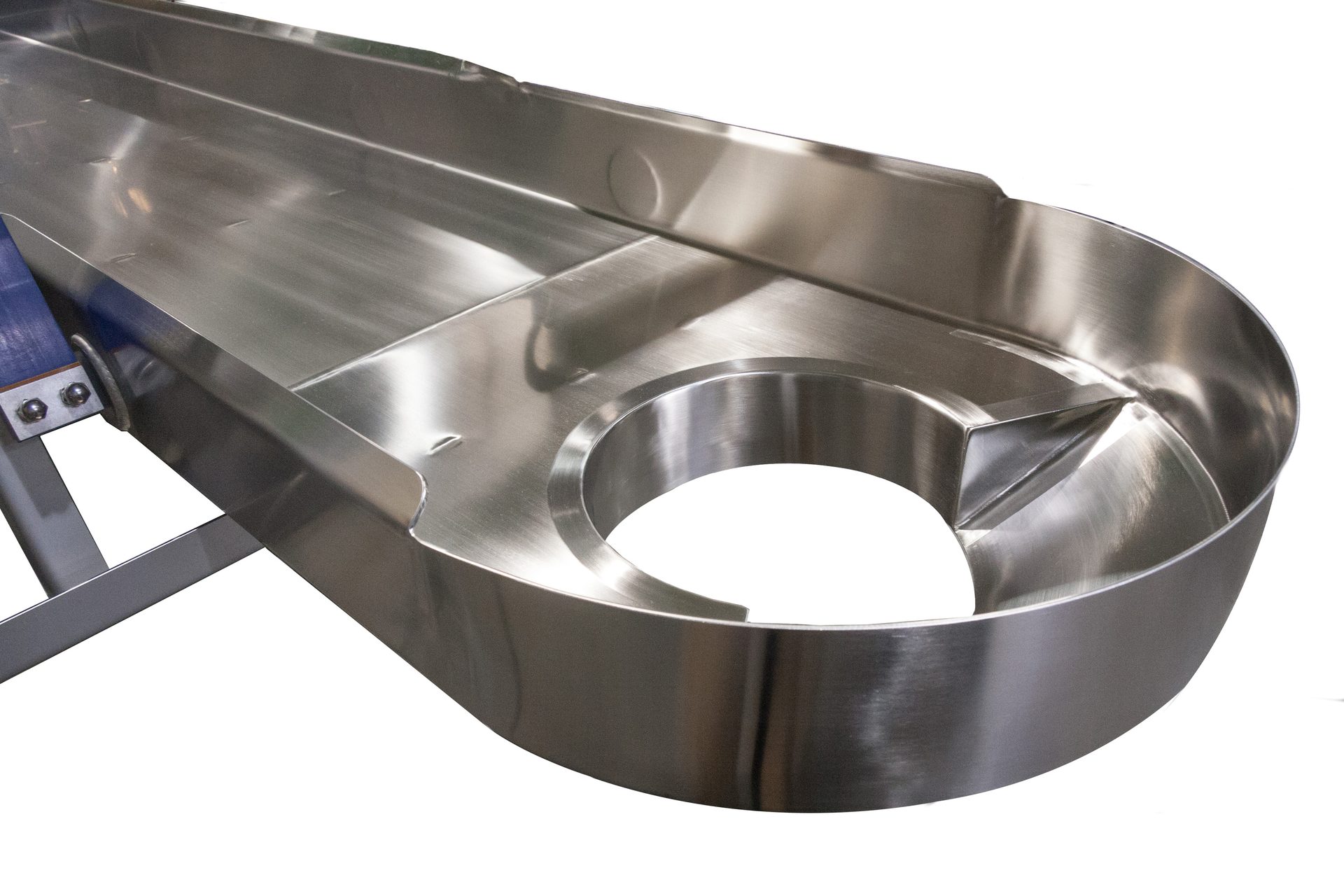
Key Technology’s Scale Feed Shaker for dairy. Photo courtesy of Key Technology.
Connecting the line
While conveyors and palletizers have traditionally been viewed as separate systems, today’s dairy processors are increasingly integrating them into a unified, fully automated production line. Sanchez says vibratory conveyor integration is key to this process, enabling seamless transfer of product throughout the line.
As dairy plants continue to automate, suppliers agree: The next wave of development will focus on smarter, more connected systems. Looking ahead, Sagona anticipates increased accessibility and improvements to tools like AI-driven pattern building and predictive maintenance.
“Store-ready pallets are showing up more often too, so palletizers will need to be flexible and simple enough to handle those changes on the fly,” he says. “With space at a premium, compact setups that can serve multiple lines will be key. Sustainability is also front and center, so dairies will want equipment that tracks energy use and cuts down on waste.”
Yeigh adds that predictive maintenance will be essential moving forward, alongside a strengthened focus on OEE (overall equipment effectiveness). He also emphasizes advances in worker safety, such as OSHA-compliant minor servicing that allows operators to manage anomalies without fully shutting down the machine. “This shortens the downtime event and allows the operator to resume automatic operation in a shorter period of time, leading to increased OEE, productivity and throughput,” he says.
From conveyors that optimize product flow to palletizers that streamline end-of-line operations, dairy producers are investing in automated systems designed to optimize sanitation and flexibility efforts. By integrating conveyors and palletizers into a single system, dairy plants can keep pace with shifting production demands, ensure proper sanitation, maintain ideal product quality and minimize labor complications. DF